

Tuesday, 12 October 2010
3D Buildings
Due to some more feedback I have made the buildings at the top 3D which I think sets the image off quite nice. I have also gotten rid of the back of the sign and will make the "Digital Piracy" text part of the sign so they will both flicker. I also tried adding a moon but didnt like the way it looked.

Development of design

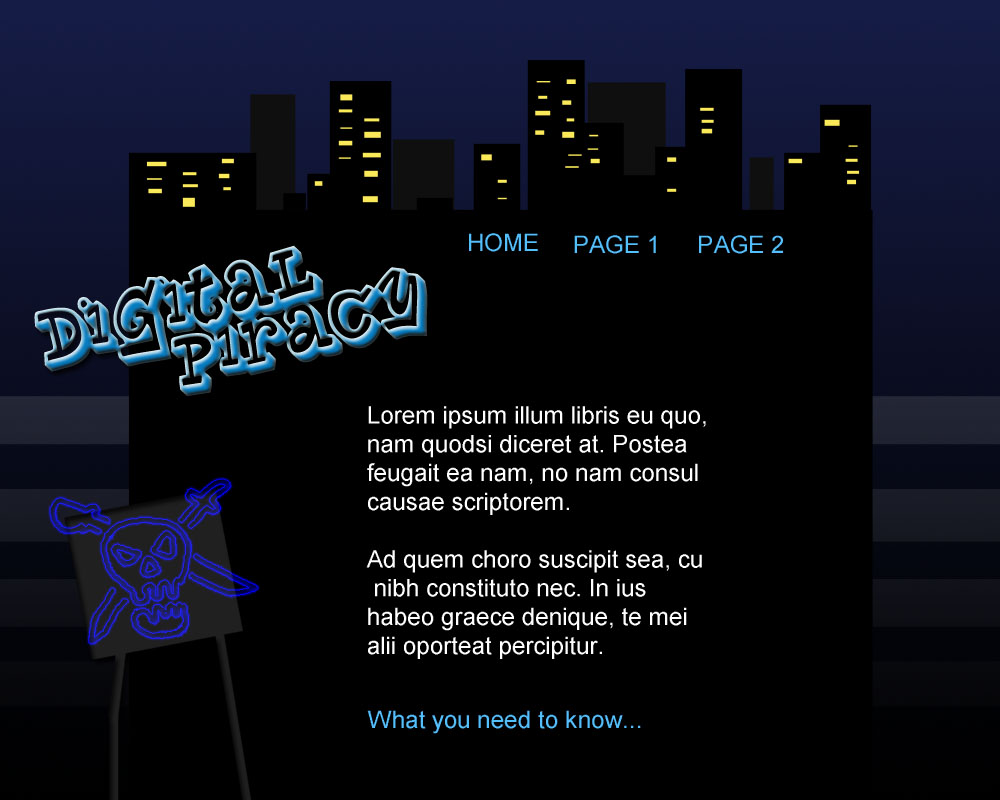

Some of the things they pointed out was that this design was better for my target audience (11-16 year old) with its grunge/city style. I was advised by my tutor and peers to create some more depth on the page, it was suggested that I do this with a simple gradient - blue to black which I have done and it really brings out the cityscape. I have also added a few stars which add a little bit extra to the overall image of the page.
I intend to make the lights in the buildings change a little and the perhaps the stars to twinkle slightly, I will try to do this with a JavaScript image change or failing that I will use flash. I also want to make the pirate sign less obvious at first but to make it act like a faulty neon sign, so it will light up off and on as if it is broken. I also need to make the back of the sign less obvious.
Sunday, 10 October 2010
BEN AND JERRY'S WEBSITE
LOVE IT


Everything from start to finish on this site is fun to look at or interact with ENJOY
Neon Design
I have been playing around with the Neon sign design a little bit, adapting the color scheme etc.


Saturday, 9 October 2010
Design Ideas


When I first thought about a design for a website about Piracy I could'nt get the image of a cartoon pirate and a sandcastle out of my head, as fun as it was to try to draw a pirate (of which I failed miserably) I thought that this sort of image would be quite patronising to children aged 11-16.
Then when I was clearing out some leaflets I had managed to collect over the past couple of weeks I came across one which had an image of a skull.

This image got me thinking about using the pirate skull and crossbones image and it also got me thinking about displaying the website with this image as a neon light. I took a look at the website that was connected with the leaflet.
 |
| Baa Bar |


This image reminded me of leading to Vegas, neon signs in the desert, it plays on the idea that playing with piracy is like playing with the law.
I also wanted to develop another idea I have which was to play on the whole British police theme, after all piracy is breaking the law. so how could I use this idea of UK police branding and make it look appealing to young people as a website?


I quickly thought about having a section of the site for parents to be able to get information about piracy so that they will feel confident in what their children are accessing through the home computer. I found some websites that have given me information designed for parents and teachers so i have been able to look at what sort of advise they are being given and how it has been put across.


Wednesday, 6 October 2010
Research
With my target audience in mind I have looked to see if there are any websites that have been created already for this purpose (to inform people of a high school age about piracy)


 This first ones I found were pages within larger websites which explained piracy but more for the purpose of how the company stood with regards to it.

 These two seemed to have a theme or consistancy about them with was nice but again, didnt look at my target audience (or if they do I dont find them engaging enough for them)
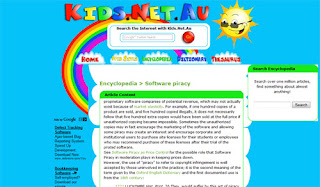 This last one has the look of being made for kids which is great, the theme is all there, there is a fun navigation and the text at the top grabs you but ones you start reading the content you soon realise it was not intended to be read by children.
I will create a site that looks like it for 11-16 year olds but also reads like it is for 11-16 year olds, not so much to lecture but to inform.


I will create a site that looks like it for 11-16 year olds but also reads like it is for 11-16 year olds, not so much to lecture but to inform.
Tuesday, 5 October 2010
Simulated Client Project
Initial Thoughts

When given the brief for this three week project I thought, keep it straight, keep it simple so I want to create a website that informs people about piracy.
When thinking further about my project I realised that this an extremely broad subject to cover, so I need to narrow it down some. I have done this by thinking about who my target audience will be. I thought about what i know about people who create or use pirated software, music, films or whatever, I thought that most of these people are my peers, non of which want to be lectured about piracy as by now they all know how it works. then I thought about other people I know who are copying films and music without realising they were breaking the law.
I knew someone who was over 60 and had been shown how to download films old and new and burn them to disks, this person thought this was fantastic as they could create DVDs for the grand kids to watch as they came to visit even before the films had made it to the cinema. They had an idea that doing this was wrong but no idea that doing this was illegal.
I then thought about high school age people (11-16) who regularly download music from all sort of places legal and illegal. I imagine again that these people at some point have been shown how to do this and have just continued to do so to increase their music collection. I am sure that many of these kids know that what they are doing is wrong but how many of them know it is Illegal. People tend to have wrong on one side and illegal on the other and sometimes forget to merge the two.


When given the brief for this three week project I thought, keep it straight, keep it simple so I want to create a website that informs people about piracy.
When thinking further about my project I realised that this an extremely broad subject to cover, so I need to narrow it down some. I have done this by thinking about who my target audience will be. I thought about what i know about people who create or use pirated software, music, films or whatever, I thought that most of these people are my peers, non of which want to be lectured about piracy as by now they all know how it works. then I thought about other people I know who are copying films and music without realising they were breaking the law.
I knew someone who was over 60 and had been shown how to download films old and new and burn them to disks, this person thought this was fantastic as they could create DVDs for the grand kids to watch as they came to visit even before the films had made it to the cinema. They had an idea that doing this was wrong but no idea that doing this was illegal.
I then thought about high school age people (11-16) who regularly download music from all sort of places legal and illegal. I imagine again that these people at some point have been shown how to do this and have just continued to do so to increase their music collection. I am sure that many of these kids know that what they are doing is wrong but how many of them know it is Illegal. People tend to have wrong on one side and illegal on the other and sometimes forget to merge the two.

The Beginning of the End
Well its in at the deep end at the minute I guess. I've been introduced to the final year of my degree at Trent and the first project has already got me up at 10pm working (and its only the 3rd day!!)
This year will be broken up into three main parts; Client, PRP and good old SPP.
The Client part is then consists of two projects, the first of which will tie me up for the first 3 weeks. This is the Simulated Client Project which is to create a short Multimedia piece that informs or illustrates Piracy. This gives me time to secure my Live client project which will be a website for a chain of pastry shops in Romania.
I am still unsure at this time of the schedule for the PRP section, although I need to have my subject approved by my tutor. I am hoping to look at Portfolio Websites and the different requirements for different disciplines.
The SPP modules for this year are aimed to get us thinking about life after uni, one involves looking at portfolios and the other applying for various positions. More on this at a later date.
This year will be broken up into three main parts; Client, PRP and good old SPP.
The Client part is then consists of two projects, the first of which will tie me up for the first 3 weeks. This is the Simulated Client Project which is to create a short Multimedia piece that informs or illustrates Piracy. This gives me time to secure my Live client project which will be a website for a chain of pastry shops in Romania.
I am still unsure at this time of the schedule for the PRP section, although I need to have my subject approved by my tutor. I am hoping to look at Portfolio Websites and the different requirements for different disciplines.
The SPP modules for this year are aimed to get us thinking about life after uni, one involves looking at portfolios and the other applying for various positions. More on this at a later date.
Tuesday, 21 September 2010
3D TV
Just some thought on the latest TV craze to date - 3D TV

A friend of mine refuses to see films in the cinema that are in 3D because he hates when films have been comprimised just to get the 'popping out of the screen' shot and include knee jerkers. I however do enjoy these features but I also think that 3D is not about having things flying out at you, it has in some films such as Alice in Wonderland, been used really cleverly to greater portray the emotions of the characters. 3D technology has become a fantastic tool for movie makers to greater explore depth within the scenes. Having loved 3D in the cinema for many years I was really excited by this idea of 3D in the average household but now that I have been around it for a while - having had to sell the things to people, I do feel it to be, at least at this stage, a bit of a gimic that I dont think will stick.
For one thing, they are expensive, which is not really an issue as I know this will not be for long and soon the prices will come down but also there are not many channels being broadcasted in 3D or filmed with 3D cameras so why invest all that money for a feature you can hardley use?
If your not too sure how 3D technology that has been designed for the home works i'll try to quickly explain it. There are two ways of viewing 3D, one which is Passive and one which is Active.

Passive
Passive technology is the type that cinemas use and what the pubs are starting to invest in for its customers to view 3D football. Passive technology uses two images that are polarized in different directions, the lenses on the glasses you wear use circular polarization and are set in oposite directions to match the two images being projected. Each lens blocks the oposite eye allowing your brain to do the hard work by putting the two images together making you see one solid image and gives you that 3D effect.
 Active
Active technology is the technology used with home TVs (however this is changing - (http://www.which.co.uk/technology/tv-and-dvd/reviews-ns/lg-3d-tvs/) The glasses hold just as much of the technology as the TV does, they shut the light out of one eye whilst leaving the other to view the image, then it switches so the other eye sees the image at a slightly different angle creating the 3D effect.
I went on some core vision training in Leeds recently and we had the chance to find out more about TV technology in genreal but also we looked at and descussed 3D. We mostly agreed that another disadvantage is that you have to wear the glasses. I struggle to imagine my mum and dad sat on the sofa wearing these 3D glasses which are at least £60 a pop especially seeing as my dad wears glasses and the 3D glasses are particularly uncomfortable for people who already wear glasses. When I wore the glasses I found the flickering to be irritating and I found some scenes were blured which was dissorientating. However some scenes were crips clear and breathtaking. It was the unconsistancy of the picture quality throughout the demo that left me feeling dissapointed.
I am left thinking that at this stage I would not buy a 3D TV but I am hopeing that this is simply the first wave of this technology and that it will only get better.
.....................................................................................................................................................................
3D in other areas
Although 3D in the home did not grab me I heared of another way that companies have been using this technology within their marketing stratagies.

Vestas, a company which originates from Denmark, who produces wind turbines have created a 3D symulator for potential clients to be able to see what it is they would be buying if they purchased through Vestas. The symulator walks them from the entrance gate right through the turbines and even inside them. A demonstration like this could have them leave feeling little in awe.
"The technology used in our wind turbines is state-of-the-art. Therefore we need state-of-the-art tools to develop them. The VR installation has proved to be a very powerful day to day tool for all engineers in our R&D department. As a side bonus the installation has also turned out to be very useful for all the other departments in Vestas like sales, management, production and service." Allan Laursen Molbech, Pro/E & VR Administrator, - http://www.virtalis.com/market-sectors/power
I am told that this simulator can be taken to the client which is an important advantage, I think this tool is very advantageous and be used in many ways for lots of different companies also.

A friend of mine refuses to see films in the cinema that are in 3D because he hates when films have been comprimised just to get the 'popping out of the screen' shot and include knee jerkers. I however do enjoy these features but I also think that 3D is not about having things flying out at you, it has in some films such as Alice in Wonderland, been used really cleverly to greater portray the emotions of the characters. 3D technology has become a fantastic tool for movie makers to greater explore depth within the scenes. Having loved 3D in the cinema for many years I was really excited by this idea of 3D in the average household but now that I have been around it for a while - having had to sell the things to people, I do feel it to be, at least at this stage, a bit of a gimic that I dont think will stick.
For one thing, they are expensive, which is not really an issue as I know this will not be for long and soon the prices will come down but also there are not many channels being broadcasted in 3D or filmed with 3D cameras so why invest all that money for a feature you can hardley use?
If your not too sure how 3D technology that has been designed for the home works i'll try to quickly explain it. There are two ways of viewing 3D, one which is Passive and one which is Active.

Passive
Passive technology is the type that cinemas use and what the pubs are starting to invest in for its customers to view 3D football. Passive technology uses two images that are polarized in different directions, the lenses on the glasses you wear use circular polarization and are set in oposite directions to match the two images being projected. Each lens blocks the oposite eye allowing your brain to do the hard work by putting the two images together making you see one solid image and gives you that 3D effect.

Active technology is the technology used with home TVs (however this is changing - (http://www.which.co.uk/technology/tv-and-dvd/reviews-ns/lg-3d-tvs/) The glasses hold just as much of the technology as the TV does, they shut the light out of one eye whilst leaving the other to view the image, then it switches so the other eye sees the image at a slightly different angle creating the 3D effect.
I went on some core vision training in Leeds recently and we had the chance to find out more about TV technology in genreal but also we looked at and descussed 3D. We mostly agreed that another disadvantage is that you have to wear the glasses. I struggle to imagine my mum and dad sat on the sofa wearing these 3D glasses which are at least £60 a pop especially seeing as my dad wears glasses and the 3D glasses are particularly uncomfortable for people who already wear glasses. When I wore the glasses I found the flickering to be irritating and I found some scenes were blured which was dissorientating. However some scenes were crips clear and breathtaking. It was the unconsistancy of the picture quality throughout the demo that left me feeling dissapointed.
I am left thinking that at this stage I would not buy a 3D TV but I am hopeing that this is simply the first wave of this technology and that it will only get better.
.....................................................................................................................................................................
3D in other areas
Although 3D in the home did not grab me I heared of another way that companies have been using this technology within their marketing stratagies.

Vestas, a company which originates from Denmark, who produces wind turbines have created a 3D symulator for potential clients to be able to see what it is they would be buying if they purchased through Vestas. The symulator walks them from the entrance gate right through the turbines and even inside them. A demonstration like this could have them leave feeling little in awe.
"The technology used in our wind turbines is state-of-the-art. Therefore we need state-of-the-art tools to develop them. The VR installation has proved to be a very powerful day to day tool for all engineers in our R&D department. As a side bonus the installation has also turned out to be very useful for all the other departments in Vestas like sales, management, production and service." Allan Laursen Molbech, Pro/E & VR Administrator, - http://www.virtalis.com/market-sectors/power
I am told that this simulator can be taken to the client which is an important advantage, I think this tool is very advantageous and be used in many ways for lots of different companies also.
Sunday, 15 August 2010
Hellmanns Website
Was browsing the web when I came accross the website for hellmanns sauce, I thought I'd add the link as I found the site nice and refreshing. I like how the imagary is used in it with the leaves moving a little to mimic a small breeze. I also like how the background image stays still while the content boxes scroll.
http://www.hellmanns.co.uk/flash.php
http://www.hellmanns.co.uk/flash.php
Subscribe to:
Posts (Atom)


 Posts
Posts


